The Haldimand Tract · the byelection of 7 December 2026
Settle the title. Keep every home.
The Haldimand Tract carries a Crown interest that has never been discharged. It belongs to the Loyalist Mohawk posterity of the three villages, not to any band. Here are the bills that settle it, for Parliament and for Ontario, and the letters to every member along the river and to the two councils on the Tract, from 18 November 2026.
The Proclamation is recognised as an interest held by the Loyalist Mohawk posterity of the three villages: exclusive, not shared, and not held or surrendered by any band.
The Nation's Register
Membership of the class is proved by the Nation's own Register, on oath before a justice of the peace. A notice in the Gazette is notice to all.
Land returns as it falls free
Surplus Crown land and decommissioned assets, police and fire vehicles among them, pass to the Nation; land sold for taxes or escheated vests in it; at a foreclosure the Nation may buy in good faith.
No one is dispossessed
No home, farm or registered title that does not conflict with the interest is disturbed. Nothing is taken; things return as they fall free.
The constitution observed
Section 109 of the Constitution Act, 1867 preserved the interest, and section 52 makes it prevail. The bills bring the statute book into line, as the Manitoba Language Reference allowed.
Ready to introduce
Five drafts: a private member's bill and a government bill for the House of Commons, a public bill for the Senate, and a private member's bill and a government bill for Ontario.
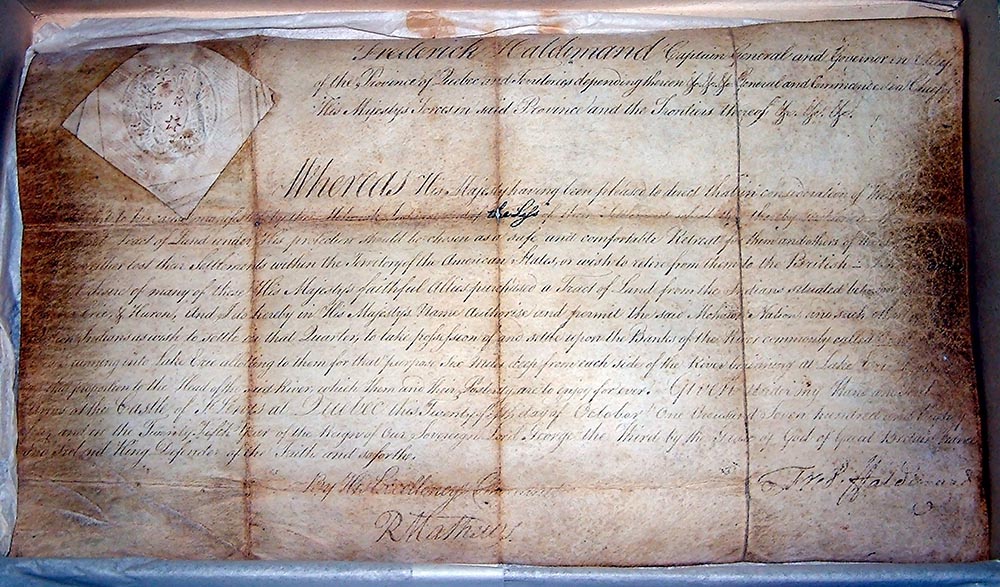
The bills keep one instrument: the Proclamation of 25 October 1784, in the King’s name. This is the parchment itself.
Each is drafted for introduction as it stands. The private member's bills are for any member to bring forward; the government bills are for a Minister of the Crown. Bill numbers are assigned on introduction.
House of Commons of Canada
Haldimand Proclamation Recognition Act
Private Member's Bill · Bill C-___
An Act respecting the observance of the Haldimand Proclamation of 1784
Recognises the interest as preserved by section 109 and guaranteed by section 52.
Returns surplus federal land and assets in the Tract to the class as they fall free.
Takes no home, no farm and no reserve lot from anyone.
letters answered so far. Each square is a letter; it fills when the member answers in writing. The Record of Correspondence keeps every answer.
The letters
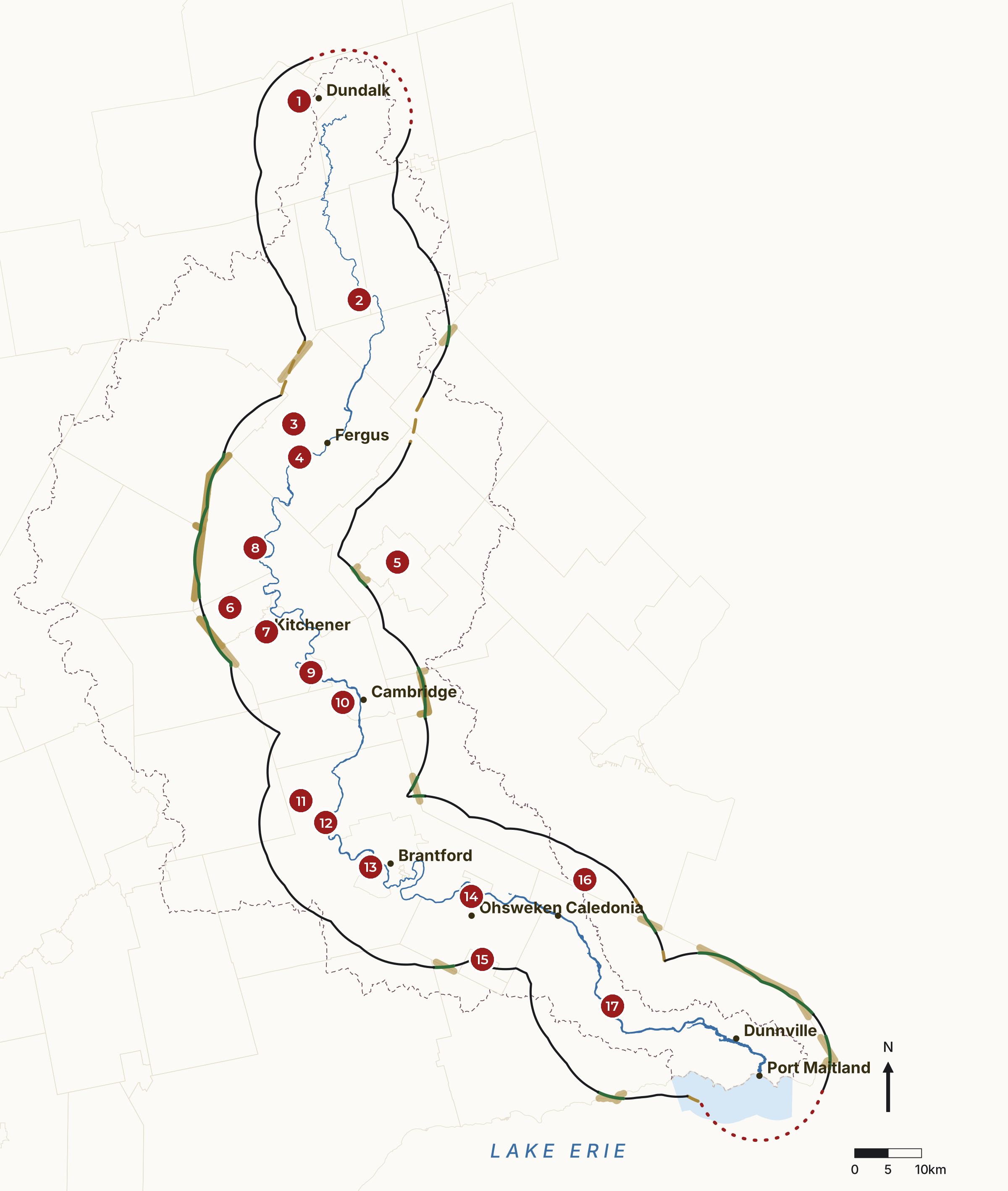
Every letter carries its Record Code in the Nation's Register and the Nation's map with the riding marked. The number beside each is its place on the map.
The byelection in Brantford–Brant South, 7 December 2026
13
The Honourable Pierre Poilievre, P.C., M.P.Leader of the Official OppositionOffice of the Leader of the Official Opposition, House of Commons, Ottawa, ON K1A 0A6 · no stamp neededpierre.poilievre@parl.gc.ca (the House’s standard address)CORR01-261118-000001Awaiting an answersha256 0a506906f49d…
Mr. Alex Ruff, M.P.Bruce–Grey–Owen Sound208-1101 2nd Avenue E, Owen Sound, ON N4K 2J1 · no stamp neededalex.ruff@parl.gc.ca (the House’s standard address)519-371-1059CORR01-261118-000024Awaiting an answersha256 4213511bb5a9…
Mr. Kyle Seeback, M.P.Dufferin–Caledon3-180 Broadway, Orangeville, ON L9W 1K3 · no stamp neededkyle.seeback@parl.gc.ca519-941-1832CORR01-261118-000005Awaiting an answersha256 047ac273bfee…
Mr. John Nater, M.P.Perth–Wellington1-93 St. Vincent Street N, Stratford, ON N5A 6H5 · no stamp neededjohn.nater@parl.gc.ca (the House’s standard address)519-273-1400CORR01-261118-000025Awaiting an answersha256 ef74824bf598…
The Honourable Michael Chong, P.C., M.P.Wellington–Halton Hills NorthA-190 St. David Street S, Fergus, ON N1M 2L3 · no stamp neededmichael.chong@parl.gc.ca (the House’s standard address)519-843-7344CORR01-261118-000006Awaiting an answersha256 bd90b1436c59…
The Honourable Bardish Chagger, P.C., M.P.Waterloo360-100 Regina Street S, Waterloo, ON N2J 4P9 · no stamp neededbardish.chagger@parl.gc.ca519-746-1573CORR01-261118-000011Awaiting an answersha256 7325dab70f35…
Ms. Kelly DeRidder, M.P.Kitchener Centre201-130 Weber Street W, Kitchener, ON N2H 4A2 · no stamp neededkelly.deridder@parl.gc.ca (the House’s standard address)519-746-8867CORR01-261118-000008Awaiting an answersha256 5acbce1c7cb8…
Mr. Tim Louis, M.P.Kitchener–Conestoga624-1187 Fischer-Hallman Road, Kitchener, ON N2E 4H9 · no stamp neededtim.louis@parl.gc.ca519-578-3777CORR01-261118-000009Awaiting an answersha256 b5a767150c93…
Mr. Matt Strauss, M.P.Kitchener South–Hespeler1114-100 Conestoga College Boulevard, Kitchener, ON N2P 2N6 · no stamp neededmatt.strauss@parl.gc.ca519-571-3100CORR01-261118-000010Awaiting an answersha256 b094baff57e7…
Ms. Connie Cody, M.P.Cambridge206-73 Water Street N, Cambridge, ON N1R 7L6 · no stamp neededconnie.cody@parl.gc.ca (the House’s standard address)519-624-2828CORR01-261118-000012Awaiting an answersha256 c4dc70c881ac…
Mr. Arpan Khanna, M.P.Oxford2-28 Finkle Street, Woodstock, ON N4S 3C6 · no stamp neededarpan.khanna@parl.gc.ca519-421-7214CORR01-261118-000026Awaiting an answersha256 d793643e45cb…
Mr. Dan Muys, M.P.Flamborough–Glanbrook–Brant North6 Main St S, P.O. Box 1100, St. George, ON N0E 1N0 · no stamp neededdan.muys@parl.gc.ca519-448-1483CORR01-261118-000014Awaiting an answersha256 7a3b6f290f20…
Dr. Leslyn Lewis, M.P.Haldimand–Norfolk240-185 Robinson Street, Simcoe, ON N3Y 5L6 · no stamp neededleslyn.lewis@parl.gc.ca519-426-3400CORR01-261118-000013Awaiting an answersha256 ff44901e83a9…
Members of the Legislative Assembly of Ontario along the river
1
Mr. Paul Vickers, M.P.P.Bruce–Grey–Owen SoundSuite 105B, 345 8th Street E, Owen Sound, ON N4K 1L3paul.vickers@pc.ola.org519-371-2421CORR01-261118-000027Awaiting an answersha256 2174a95cc591…
The Honourable Sylvia Jones, M.P.P.Dufferin–CaledonSuite A, 3rd Floor, 180 Broadway Ave., Orangeville, ON L9W 1K3sylvia.jones@pc.ola.org519-941-7751CORR01-261118-000015Awaiting an answersha256 b5c8d1f9e452…
Mr. Matthew Rae, M.P.P.Perth–WellingtonUnit 2, 55 Lorne Ave. E, Stratford, ON N5A 6S4matthew.rae@pc.ola.org519-272-0660CORR01-261118-000028Awaiting an answersha256 60e8b695b718…
Mr. Joseph Racinsky, M.P.P.Wellington–Halton Hills2nd Floor, 181 St. Andrew St. E, Fergus, ON N1M 1P9joseph.racinsky@pc.ola.org519-787-5247CORR01-261118-000016Awaiting an answersha256 51a613b9cd4b…
Mr. Mike Schreiner, M.P.P.GuelphUnit 102, 173 Woolwich St., Guelph, ON N1H 3V4mschreiner@ola.org519-836-4190CORR01-261118-000017Awaiting an answersha256 3cd00613178e…
Ms. Catherine Fife, M.P.P.WaterlooSuite 220, 100 Regina St. S, Waterloo, ON N2J 4P9cfife-qp@ndp.on.ca519-725-3477CORR01-261118-000022Awaiting an answersha256 352f83e13f71…
Ms. Aislinn Clancy, M.P.P.Kitchener CentreSuite 605, 305 King St. W, Kitchener, ON N2G 1B9aclancy-qp@ola.org519-579-5460CORR01-261118-000018Awaiting an answersha256 cbbce1acd8ae…
Mr. Mike Harris, M.P.P.Kitchener–ConestogaUnit 3 & 4, 63 Arthur St. S, Elmira, ON N3B 2M6mike.harris@pc.ola.org519-669-2090CORR01-261118-000019Awaiting an answersha256 076def5e549b…
Ms. Jess Dixon, M.P.P.Kitchener South–HespelerBuilding A, Unit 11, 260 Holiday Inn Dr., Cambridge, ON N3C 2E8jess.dixon@pc.ola.org519-650-9413CORR01-261118-000020Awaiting an answersha256 bd995a6d662e…
Mr. Brian Riddell, M.P.P.CambridgeCambridge Place, Suite 60, 173 Water St. N, Cambridge, ON N1R 7L6brian.riddell@pc.ola.org519-650-2770CORR01-261118-000021Awaiting an answersha256 ef6618cb9e7a…
Mr. Ernie Hardeman, M.P.P.Oxford12 Perry St., Woodstock, ON N4S 3C2ernie.hardeman@pc.ola.org519-537-5222CORR01-261118-000029Awaiting an answersha256 d6073c0b7490…
Mr. Will Bouma, M.P.P.Brantford–BrantSuite 101, 96 Nelson St., Brantford, ON N3T 2N1will.bouma@pc.ola.org519-759-0361CORR01-261118-000023Awaiting an answersha256 30c75626ce97…
The Honourable Donna Skelly, M.P.P., SpeakerFlamborough–GlanbrookSuite 104, 2000 Garth St., Hamilton, ON L9B 0C1donna.skelly@pc.ola.org905-679-3770CORR01-261118-000030Awaiting an answersha256 42cbb18c53e9…
Ms. Bobbi Ann Brady, M.P.P.Haldimand–Norfolk50B Gilbertson Dr., Simcoe, ON N3Y 4L8babrady-co@ola.org519-428-0446CORR01-261118-000004Awaiting an answersha256 7fefa33ee817…
To the Speaker, the Government Representative, the leader of each group, and every senator for Ontario, where the Tract lies: will one of them introduce the Senate public bill?
The Honourable Raymonde GagnéSpeaker of the SenateThe Senate of Canada, Ottawa, ON K1A 0A4 · no stamp neededRaymonde.Gagne@sen.parl.gc.caCORR01-261118-000043Awaiting an answersha256 64580ed2b237…
The Honourable Pierre MoreauRepresentative of the Government in the SenateThe Senate of Canada, Ottawa, ON K1A 0A4 · no stamp neededPierre.Moreau@sen.parl.gc.caCORR01-261118-000044Awaiting an answersha256 a034ceda6a76…
The Honourable Leo HousakosLeader of the Opposition in the SenateThe Senate of Canada, Ottawa, ON K1A 0A4 · no stamp neededLeo.Housakos@sen.parl.gc.caCORR01-261118-000045Awaiting an answersha256 968a71f1aa78…
The Honourable Brian FrancisLeader of the Progressive Senate GroupThe Senate of Canada, Ottawa, ON K1A 0A4 · no stamp neededBrian.Francis@sen.parl.gc.caCORR01-261118-000046Awaiting an answersha256 65a5f9e34d4e…
The Honourable Flordeliz (Gigi) OslerLeader of the Canadian Senators GroupThe Senate of Canada, Ottawa, ON K1A 0A4 · no stamp neededFlordeliz.Osler@sen.parl.gc.caCORR01-261118-000047Awaiting an answersha256 e1cd6e14aade…
The Honourable Salma AtaullahjanSenator for OntarioThe Senate of Canada, Ottawa, ON K1A 0A4 · no stamp neededSalma.Ataullahjan@sen.parl.gc.caCORR01-261118-000048Awaiting an answersha256 23ab96eeacb0…
The Honourable Robert BlackSenator for OntarioThe Senate of Canada, Ottawa, ON K1A 0A4 · no stamp neededRobert.Black@sen.parl.gc.caCORR01-261118-000049Awaiting an answersha256 c20763ab48a0…
The Honourable Peter M. BoehmSenator for OntarioThe Senate of Canada, Ottawa, ON K1A 0A4 · no stamp neededPeter.Boehm@sen.parl.gc.caCORR01-261118-000050Awaiting an answersha256 496878301c7f…
The Honourable Yvonne BoyerSenator for OntarioThe Senate of Canada, Ottawa, ON K1A 0A4 · no stamp neededYvonne.Boyer@sen.parl.gc.caCORR01-261118-000051Awaiting an answersha256 570c1d0da635…
The Honourable Sharon BureySenator for OntarioThe Senate of Canada, Ottawa, ON K1A 0A4 · no stamp neededSharon.Burey@sen.parl.gc.caCORR01-261118-000052Awaiting an answersha256 2802b13b57c3…
The Honourable Andrew CardozoSenator for OntarioThe Senate of Canada, Ottawa, ON K1A 0A4 · no stamp neededAndrew.Cardozo@sen.parl.gc.caCORR01-261118-000053Awaiting an answersha256 14eaad8937b5…
The Honourable Bernadette ClementSenator for OntarioThe Senate of Canada, Ottawa, ON K1A 0A4 · no stamp neededBernadette.Clement@sen.parl.gc.caCORR01-261118-000054Awaiting an answersha256 c8a0b623771f…
The Honourable Marty DeaconSenator for OntarioThe Senate of Canada, Ottawa, ON K1A 0A4 · no stamp neededMarty.Deacon@sen.parl.gc.caCORR01-261118-000055Awaiting an answersha256 5d9b93c75bed…
The Honourable Tony DeanSenator for OntarioThe Senate of Canada, Ottawa, ON K1A 0A4 · no stamp neededTony.Dean@sen.parl.gc.caCORR01-261118-000056Awaiting an answersha256 f3c44d1324de…
The Honourable Peter HarderSenator for OntarioThe Senate of Canada, Ottawa, ON K1A 0A4 · no stamp neededPeter.Harder@sen.parl.gc.caCORR01-261118-000057Awaiting an answersha256 288ebf8f2868…
The Honourable Katherine HaySenator for OntarioThe Senate of Canada, Ottawa, ON K1A 0A4 · no stamp neededKatherine.Hay@sen.parl.gc.caCORR01-261118-000058Awaiting an answersha256 ec641e4a7bcc…
The Honourable Marnie McBeanSenator for OntarioThe Senate of Canada, Ottawa, ON K1A 0A4 · no stamp neededMarnie.McBean@sen.parl.gc.caCORR01-261118-000059Awaiting an answersha256 e6a3b3b7bb73…
The Honourable Farah MohamedSenator for OntarioThe Senate of Canada, Ottawa, ON K1A 0A4 · no stamp neededFarah.Mohamed@sen.parl.gc.caCORR01-261118-000060Awaiting an answersha256 0a671f0a40bf…
The Honourable Lucie MoncionFacilitator of the Independent Senators Group, Senator for OntarioThe Senate of Canada, Ottawa, ON K1A 0A4 · no stamp neededLucie.Moncion@sen.parl.gc.caCORR01-261118-000061Awaiting an answersha256 e748f8e14346…
The Honourable Rosemary MoodieSenator for OntarioThe Senate of Canada, Ottawa, ON K1A 0A4 · no stamp neededRosemary.Moodie@sen.parl.gc.caCORR01-261118-000062Awaiting an answersha256 a9c051fb50fb…
The Honourable Kim PateSenator for OntarioThe Senate of Canada, Ottawa, ON K1A 0A4 · no stamp neededKim.Pate@sen.parl.gc.caCORR01-261118-000063Awaiting an answersha256 a52ff27ad566…
The Honourable Rebecca PattersonSenator for OntarioThe Senate of Canada, Ottawa, ON K1A 0A4 · no stamp neededRebecca.Patterson@sen.parl.gc.caCORR01-261118-000064Awaiting an answersha256 e9cf8d822099…
The Honourable Sandra PupatelloSenator for OntarioThe Senate of Canada, Ottawa, ON K1A 0A4 · no stamp neededSandra.Pupatello@sen.parl.gc.caCORR01-261118-000065Awaiting an answersha256 20187af07b92…
The Honourable Paulette SeniorSenator for OntarioThe Senate of Canada, Ottawa, ON K1A 0A4 · no stamp neededPaulette.Senior@sen.parl.gc.caCORR01-261118-000066Awaiting an answersha256 1de9fbf558b4…
The Honourable Toni VaroneSenator for OntarioThe Senate of Canada, Ottawa, ON K1A 0A4 · no stamp neededToni.Varone@sen.parl.gc.caCORR01-261118-000067Awaiting an answersha256 f0a2a2891f8a…
The Honourable Hassan YussuffSenator for OntarioThe Senate of Canada, Ottawa, ON K1A 0A4 · no stamp neededH.Yussuff@sen.parl.gc.caCORR01-261118-000068Awaiting an answersha256 7a5805a25703…
Elected Chief Sherri-Lyn Hill and CouncilSix Nations of the Grand River Elected CouncilCentral Administration, PO Box 5000, Ohsweken, ON N0A 1M0sixnations.ca519-445-2201CORR01-261118-000031Awaiting an answersha256 0e801341f996…
Chief Margaret Sault and CouncilMississaugas of the Credit First Nation2789 Mississauga Road, RR 6, Hagersville, ON N0A 1H0communications@mncfn.ca905-768-1133CORR01-261118-000032Awaiting an answersha256 9ff0788b3a2a…
Your own letter, in your own name, to your member of Parliament and your member at Queen’s Park, found from the ridings themselves. Tap the map, or use your location.
Is it on the Tract?
Tap any place for whether it lies within the six miles, how far it is from the line, and whose ridings it is in. The red dashes are the straight lines of 1791; the black line follows every bend.
The six miles, measured from the banksWithin the six milesThe Grand River
The Proclamation of 25 October 1784 sets the land by a measure: six miles deep from each side of the Grand River, from Lake Erie to the head of the river. Where the river runs, the line runs with it, six miles out, from every bank and every bend.
Fixed by the Constitution
The interest the Proclamation made is preserved against the Province by section 109 of the Constitution Act, 1867, and section 52 makes the Constitution prevail over any law inconsistent with it. So the line it draws is a constitutional boundary: no later survey, patent, purchase or county line moves it.
Measured on the ground
The Nation measures it from the river itself, six statute miles out on each side, by plain arithmetic and GPS positions. It does not take the line from the Simcoe Patent of 1793, which the Grand River Mohawk never accepted, nor from maps that stop the Tract short of the head of the river or draw it narrower.
More members on notice
Measured that way, the six miles reach Dundalk, Alma, Blenheim and Woodburn, and take in four ridings the first letters did not reach. Their members now have the Nation’s notice of the interest, as every member on the Tract does.
Brought in by the six miles, measured as the Proclamation says:
1
Mr. Alex Ruff, M.P.Member of Parliament for Bruce–Grey–Owen Sound · at Dundalk
Every new session of Parliament begins with a bill nobody intends to pass. The editorial asks what a Haldimand bill would look like if it were read the same way, and what it reveals when it is taken seriously.
The Grand does not run straight, and a grant measured from its banks cannot be honoured with a ruler.
A bill given first reading is printed, numbered and kept. It sits in the Journals and in Hansard, where it cannot be denied or written off as rally talk.
The Crown gave its word on this river in 1784. The theory is simple: before anyone is asked to keep that word, someone only has to read it aloud.
Four questions, answered in writing. Each letter puts them in the form that fits the member's house and party.
Will you acknowledge the interest? That the Proclamation of 1784 is an interest other than that of the Province, preserved by section 109, held by the Loyalist Mohawk posterity and not by any band.
Will you support the bill? Second it, co-sponsor it or vote for it, and press for the government bill.
Will you raise the question in your house? Members of Parliament: that no settlement of the band's 1995 action be made binding on the posterity, who are not party to it. Members of the Legislative Assembly: on what date, and by what instrument, did the Tract become part of Ontario?
Will you meet with us? Nation to Crown, to discuss the ascertainment of the class and an orderly settlement of title on the Tract.
The ridings on the Tract
The black line is six miles from the water on each side of the Grand, from its head to Lake Erie. The river is taken from the Grand River Conservation Authority's open data (GRCA Open Data Licence v2); from it the Nation measures six statute miles on the ground, by simple arithmetic and GPS positions, to build out the real six-mile constitutional boundary. Why the line is a constitutional boundary.
1
DundalkAlex Ruff · Paul Vickers
2
Grand ValleyKyle Seeback · Sylvia Jones
3
AlmaJohn Nater · Matthew Rae
4
EloraMichael Chong · Joseph Racinsky
5
GuelphDominique O'Rourke · Mike Schreiner
6
WaterlooBardish Chagger · Catherine Fife
7
KitchenerKelly DeRidder · Aislinn Clancy
8
ConestogoTim Louis · Mike Harris
9
DoonMatt Strauss · Jess Dixon
10
CambridgeConnie Cody · Brian Riddell
11
BlenheimArpan Khanna · Ernie Hardeman
12
ParisDan Muys
13
BrantfordPierre Poilievre · Joy O'Donnell · Dave Carrol · Brad Ward · Kathryn Kissinger · Dirk Byers · Mike Clancy · Leslie Bory · Will Bouma
The questions people ask, answered plainly. The same answers stand on haldimandproclamation.org and haldimandpledge.org.
Does this take my home?
No. The bills take no home, no farm and no reserve lot from anyone. Surplus Crown land returns to the Nation only as it falls free; property passes at a tax sale only after its owner has already lost it to the municipality; titles that do not conflict with the interest stand. With public notice, every buyer and every bank along the river knows of the interest, and a purchase by the Nation is a good-faith transfer made in the open.
Wasn’t it surrendered long ago?
No surrender of the Mohawk interest is recorded, and the Province’s own Director of Land Registry Services confirmed that in writing on 13 April 2026. Only the class the instruments name could surrender what they granted, and the posterity includes people not yet born: no one living can give it up for them.
Didn’t the Simcoe Patent of 1793 replace the Proclamation?
No. Simcoe’s Patent of 14 January 1793 named the “Six Nations” as one body, cut the lands to Jones’s lines and gave possession and use, not ownership. Brant and the Grand River chiefs refused it and declared it not binding on them. A deed refused by those it was offered to is no treaty with them, whatever number a map gives it. The whole account is at simcoepatent.org.
Isn’t this the Six Nations’ claim?
No. The Six Nations’ action is a collective claim of exclusive use and occupation, made under section 35. The Mohawk interest is a Crown grant to the Loyalist Mohawk of three villages and their posterity, individual and hereditary, preserved by sections 109 and 52. The posterity are not parties to that action, and nothing settled there can settle the grant of 1784.
What about the Simcoe Patent of 1793?
It was offered as the further instrument promised in 1791, and the Grand River Mohawk never accepted it. A grant refused by its grantees does not become their deed because a Crown officer wrote it out. The Proclamation stands on its own words.
Why six miles from the banks, not the lines on today’s maps?
Because the measure is in the instrument: six miles deep from each side of the river, to its head. Today’s lines come from a straight survey agreed in 1791, and the Grand does not run straight. Measured from the banks, as the grant says, the line follows every bend; the map below shows both.
Is this a land claim?
No. A claim asks for land to be granted. This interest was granted in 1784, preserved by the Constitution in 1867, and has never been surrendered. What is asked of the Crown is not to give something, but to observe what it already gave.
Who holds the interest?
The Loyalist Mohawk of Canajoharie, Tikondarago and Aughquaga, and their posterity by either sex, with those received by the Nation’s law of adoption. Descent is proved in the Nation’s own Register, on oath, as Simcoe’s Proclamation of 1796 provided.
Who would sponsor the bills?
Any member of Parliament or of the Legislature may bring in a private member’s bill; a Minister brings in a government bill. The Nation has written to every member whose riding lies on the Tract and asked one of them to sponsor it.
What does first reading do?
First reading prints the bill, numbers it and records it in the Journals and in Hansard. It is not a vote on its merits; that comes at second reading and in committee. Once read, the bill is on the record for good, and no one can say the question was never put.
Why does the original say “Five Nations”?
The original parchment of 1784, with its seal, reads “Five Nations” and “Five Nation Indians”. The registered copy printed in Indian Treaties and Surrenders (vol. 1, p. 251), the text most people quote, reads “Six”. The words on this site are the registered copy, and the difference is set out so that anyone can see it.
What’s new
simcoepatent.org joins the set: the Simcoe Patent of 14 January 1793, the deed the Grand River Mohawk refused, and who still stands on it.
The letters are posted, with the bills enclosed: to every member of Parliament and of the Legislature whose riding lies on the Tract, to all eight candidates in the Brantford–Brant South byelection, to the two councils whose reserves lie on it, and to the Senate: the Speaker, the Government Representative, the leader of each group and every senator for Ontario.
The Two Row Times editorial “Suppose It Were Read” asks what a Haldimand bill would reveal if it were read.
haldimandproclamation.org, haldimandpledge.org and haldimandbills.org open.
Cite this page
Mohawk Nation of Grand River Secretariat, “The Haldimand Bills and Letters,” 18 November 2026, https://haldimandbills.org/.